
In this issue:
-
Introducing the New MSSI Leadership Team!
-
Save the Date! Spring Advisor Meeting
-
Eating Disorder Awareness Week 2026
-
BMI as a Barrier to Accessing Abortion Care
-
Upcoming AWSIM Events
Introducing the 2026/2027 MSSI Leadership Team!
This year marks an exciting transition for Medical Students for Size Inclusivity (MSSI) as we celebrate over 20 of our members graduating medical school and moving on to residency! Our alumni have been instrumental in advocating for weight-inclusive healthcare, and we know they will continue to champion this work in their future practices.
With this transition, we are thrilled to introduce our new leadership team, a passionate group of medical students dedicated to continuing MSSI’s mission. As we step into this next chapter, we look forward to expanding our advocacy efforts, growing our community, and pushing for change in medical education and patient care. Stay tuned for updates on our initiatives, upcoming events, and ways to get involved!
Director
-
Jessica Rosenblum, Tufts University School of Medicine, Class of 2027
Secretary
-
April Ascher, University of Kansas School of Medicine, Class of 2028
Director of Chapters & Affiliates
-
Jillian Rhodes, Tufts University School of Medicine, Class of 2028
Co-Directors of Communications
-
Andrea Albano, Tufts University School of Medicine, Class of 2028
-
Megan Coolahan, Tufts University School of Medicine, Class of 2028
Research – Student Lead
-
Joe Morrison, UC Davis School of Medicine, Class of 2031 (MD/PhD)
Co-Chairs of Curriculum/Education
-
Abigail Fraust, Drexel University College of Medicine, Class of 2027
-
Divya Vemulapalli, Frank H. Netter MD School of Medicine at Quinnipiac University, Class of 2027
Co-Chairs of Advocacy
-
Jackie Liu, Harvard Medical School, Class of 2027
-
Karen Linares Quintos, Charles R. Drew University of Medicine & Science College of Medicine, Class of 2029
SAVE THE DATE: Spring Advisor Meeting
You are invited to join MSSI for our March Advisory Meeting! We will be hosting the meeting on Tuesday March 24th at 8-9pm EST. MSSI student leaders will share updates on ongoing projects and ask for feedback from MSSI advisors, other MSSI students, AWSIM clinicians, and other members of the weight-inclusive community.
MSSI advisory meetings are also an informal opportunity to mingle, network and brainstorm in community – we look forward to seeing you there!
Time Conversion:
-
Tue, March 24, 2026 7:00 pm Central Time
-
Tue, March 24, 2026 6:00 pm Mountain Time, & Alberta
-
Tue, March 24, 2026 5:00 pm AZ, Pacific Time, Vancouver
-
Wed, March 25, 2026 12:00 pm AEDT Melbourne Australia
-
Wed, March 25, 2026 1:00 am GMT Dublin Ireland
Meeting link and registration: https://tufts.zoom.us/meeting/register/iU76HPjzQu6fLJR2nB9wyw#/registration

Eating Disorder Awareness Week 2026
Eating Disorder Awareness Week generally takes place at the end of February around the world, and February 23-March 1 this year in the US. We know that through open, supportive dialogue, we, as medical students, can help break the shame and silence that affect the millions of people living with an eating disorder; and the millions of others who are struggling with food and weight preoccupation.
Eating Disorder Awareness Week is a time to raise awareness about eating disorders, their impact and to shed light on the dangerous and pervasive myths that surround them. It is a time of year when folks can learn more about eating disorders and about the resources that are available for individuals and family members who are impacted by them.
At MSSI, we firmly believe that size inclusion and fat liberation are key components of ED advocacy.
If you’re currently struggling with an eating disorder or disordered eating yourself, please know that support is available to you. There are many ways to get the help you need, from free groups to treatment and much more. Check out some of our preferred resources from Project HEAL.
You can support Project HEAL’s fundraiser at the link to help increase access to eating disorder care in the US.
You can also browse body-safe and Health at Every Size® (HAES) books and resources for patients, family and clinicians on eating disorder recovery and healing. This list compiled by Lindley at Body Liberation Photos is wonderful.

BMI as a Barrier to Accessing Abortion Care
A recent article by Gabriella Gladney in The 19th highlighted an issue many of us may not have previously considered: BMI cutoffs functioning as barriers to abortion access.
The story centres on patients like Elie Liakopoulos, who sought a surgical abortion in Oregon (a state where abortion is legally protected) only to be told she could not receive care at a clinic because her BMI exceeded their threshold. She later secured care elsewhere, but her body size again shaped her experience through altered anesthesia practices, poorly managed pain, and a traumatic procedural experience attributed to her BMI.
What does the evidence say?
The article references the following research:
-
A 2025 systematic review in Obstetrics & Gynecology found no increased risk of complications from surgical abortion associated with obesity, even after adjusting for age and gestational age.
-
A 2019 study in Perspectives on Sexual and Reproductive Health similarly found no difference in complication rates by BMI, though patients with higher BMIs were more likely to be referred out resulting in delays and increased costs.
Dr. Noora Siddiqui, a family medicine physician in Philadelphia and a fellow with Physicians for Reproductive Health, states in the article: “There’s nothing physiologically that should keep you from being able to perform these safe procedures or medications”.
BMI as a gatekeeper
BMI was never designed as an individualized clinical decision-making tool. It is a population-level epidemiologic measure, developed using data from White European men. Yet in practice, it is often used as a shorthand proxy for anesthetic risk, procedural difficulty, or facility limitations.
In abortion care, these cutoffs may reflect lack of provider training in caring for patients in larger bodies, insurance-driven anesthesia policies, equipment limitations (procedure tables, imaging modalities, BP cuffs, gowns, etc), and institutional risk aversion.
But when BMI becomes a hard exclusion criterion rather than part of individualized risk assessment, it functions as gatekeeping.
And abortion care is time-sensitive in nature, with delays having the potential to result in more days of pregnancy-related symptoms, increased procedural complexity, additional travel/childcare/lost wages, and emotional distress. Where structural barriers to abortion are already profound, especially in the USA, BMI cutoffs represent yet another layer of inequity.
Individualized clinical risk vs. structural bias
To be clear, anesthesia carries real risks. Providers must assess airway anatomy, co-morbidities, and many other factors. But risk stratification should be individualized, rather than determined by arbitrary BMI cutoffs unsupported by complication data.
When BMI is used as a disqualifier rather than a contextual data point, it shifts from being a screening tool to being a structural barrier.
What this means for us medical students:
As future physicians, we should be asking:
-
Are we using BMI to inform care or to limit it?
-
Does our clinical reasoning rely on evidence or on inherited norms?
-
Do our clinics have the equipment and training to serve patients across body sizes?
-
When we refer out, are we mitigating harm or contributing to delay?
The final quote from the article reads: “…Fat people make up more than a third of this country. If all of us are being treated more poorly simply because our bodies are larger, that’s obviously a systemic problem…”
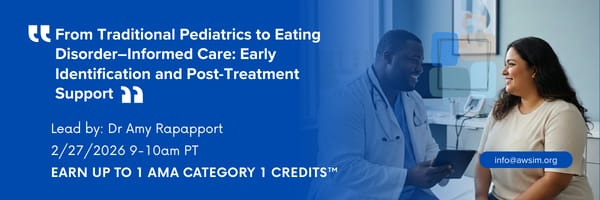
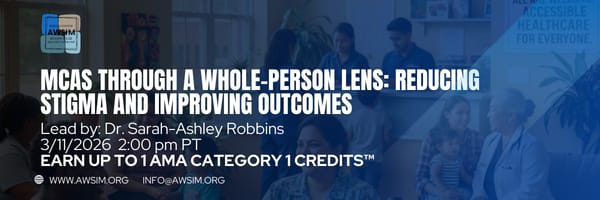
Upcoming AWSIM Events!
This newsletter was authored by MSSI member Sophie Lalonde-Bester (University of Alberta).